Of Circumcision and Prayer
Does it matter that San Francisco may ban circumcisions?
Or that a federal judge has prohibited prayer at a Texas graduation?
Yes. And for more significant reasons than the media reports suggest.
First, the news. In what has, until now, been a private family matter, a group seeking to ban the circumcision of male children in San Francisco has succeeded in getting their measure on the November ballot. If the measure passes, circumcision would be prohibited among males under the age of 18, a misdemeanor offense punishable by a fine up to $1,000 or up to one year in jail. There would be no religious exemptions. The end goal of the measure’s supporters is to make circumcision a federal crime.
Now to Texas. A federal judge has ordered a Texas school district to prohibit public prayer at a high school graduation ceremony. The judge’s order also forbids students from using specific religious words such as “prayer” and “amen.” Going further, the judge banned students and other speakers from any and all religious language in their speeches, including such words or phrases as “join in prayer,” “bow their heads,” “amen,” and “prayer.” He also ordered the school district to remove the terms “invocation” and “benediction” from the graduation program.
The ruling was in response to a lawsuit filed by the parents of a single graduating student. The judge agreed with its tenets, and declared that the family and the son would “suffer irreparable harm” if anyone ended up praying at the ceremony.
No one would deny the rights of a group of people to put a measure on a ballot for consideration by the wider population. No one would deny the right of a family to file a suit against a public school district about an educational matter involving their child.
But is that what is at hand in these cases?
Hardly.
Consider the ban on circumcision. Supporters say that male circumcision is a form of genital mutilation that is unnecessary, extremely painful and even dangerous. They say parents should not be able to force the decision on their young child. “Parents are really guardians, and guardians have to do what’s in the best interest of the child,” say Lloyd Schofield, the measure’s lead proponent. “It’s his body. It’s his choice.”
Opponents say such claims are alarmingly misleading, and call the proposal a clear violation of constitutionally protected religious freedoms. Not only is circumcision widely practiced (80% of American men are already circumcised), but medical groups uniformly say that the practice is not harmful. Further, international health organizations have promoted circumcision as an important strategy for reducing the spread of the AIDS virus, based on studies that showed it can prevents AIDS among heterosexual men in Africa.
But let’s get back to the religious dimension. The circumcision of males is a requirement of Jewish law that dates back to Abraham in Genesis. To ban it would be a direct assault on Jewish practice (Muslim practice too, for that matter). Further, the writer of the bill, Matthew Hess, writes an online comic book titled “Foreskin Man” with villains like “Monster Mohel” (a “Mohel” is a Jewish person who performs ritual circumcision). The Anti-Defamation League has already issued a statement saying the comic employs “grotesque anti-Semitic imagery.”
And the ban on prayer? We can have honest debates about whether this is a needed step to prevent the promotion of a specific religion, or whether it's unfairly keeping religion out of the public square. But the ruling did not seem to be overly concerned about any one religion's unique tenets being unduly imposed on impressionable minds. It seemed most concerned with airbrushing away any and all things religious, even preventing someone's speech from referencing their personal convictions.
And most disturbing of all, like the circumcision case, the argument seems to be promoting the harmful nature of what has been a mainstream religious practice. Take note again of the judge's ruling: prayer would cause the graduating senior to suffer "irreparable harm."
Prayer? Irreparable harm?
This is precisely the argument being made by the new pop-atheists, such as Richard Dawkins, Sam Harris and Christopher Hitchens. No matter where you stand on the role of religion in the founding of our country, to say that the First Amendment was penned as a necessary protective measure against the corrosive influence of young Valedictorians tipping their hat to a Creator is revisionist history at its worst.
Circumcision and prayer are two of the most ancient, and foundational, religious practices of the world's great monotheistic religions. If these are successfully legislated against in the name of their "harm" to individuals or society, then we have truly entered into a new day of aggressive secularism where the goal is not the protection of religious freedom, but its removal.
This is not about circumcision; it's not about prayer at graduations.
It’s about the increasingly aggressive attempt to purge faith from the public, and even private, spheres of life.
James Emery White - Church and Culture
Monday, June 6


Thursday, June 2
Effective Armor Against the Enemy of our Soul

Above all, taking the shield of faith, with which you shall be able to quench all the fiery darts of the wicked. Ephesians 6:16
Few of the children of God are ignorant, more or less, of Satan’s devices. But few are exempt from the “fiery darts ” of the adversary; our Lord Himself was not.
Many, peculiar, and great are their temptations. They are often those which touch the very vitals of the gospel, which go to undermine the believer’s faith in the fundamentals of Christianity, and which affect his own personal interest in the covenant of grace. Satan is the sworn enemy of the believer- his constant, unwearied foe. There is, too, a subtlety, a malignity, which does not mark the other and numerous enemies of the soul.
The Holy Spirit speaks of the “depths of Satan.” There are “depths” in his malice, in his subtlety, in his sagacity, which many of the beloved of the Lord are made in some degree to fathom. The Lord may allow them to go down into those “depths,” just to convince those who are there are depths in His wisdom, love, power, and grace, which can out-fathom the “depths of Satan.”
But what are some of the devices of the wicked one? What are some of his fiery darts?
- Sometimes he fills the mind of the believer with the most blasphemous and atheistical thoughts, threatening the utter destruction of his peace and confidence.
- Sometimes he takes advantage of periods of weakness, trial, and perplexity to stir up the corruptions of his nature, bringing the soul back as into captivity to the law of sin and death.
- Sometimes he suggests unbelieving doubts respecting his adoption, beguiling him into the belief that his professed conversion is all a delusion, that his religion is all hypocrisy, and that what he had thought was the work of grace is but the work of nature. . . .
But in the midst of it all, where does the comfort and the victory of the tempted believer come from? From the promise which assures him that “when the enemy shall come in like a flood, the Spirit of the Lord shall lift up a standard against him.” And what is the standard which the Spirit, the Comforter, lifts up to stem this flood? A dying, risen, ascended, exalted, and ever-living Savior. This is the standard that strikes terror into the foe; this is the gate that shuts out the flood. So the disciples proved. . . .
And let the reflection console you, that temptations only leave the traces of guilt upon the conscience, and are only regarded as sins by God, as they are yielded to. The mere suggestion of the adversary, the mere presentation of a temptation, is no sin, so long as, in the strength that is in Christ Jesus, the believer firmly and resolutely resists it. “Resist the devil, and he will flee from you.” Jesus has already fought and conquered for you. He knew well what the conflict with Satan was.
He may harass, annoy, and distress you; but pluck you from the hollow of the hand that was pierced for you, he never can.
Taken from Octavius Winslow (HERE)
Wednesday, June 1
Ten Thought-Provoking John Wesley Quotes

Recently, the John Wesley Collection (29 vols.) was placed on Pre-Pub. Not only does it contain the complete Works of John Wesley and Wesley’s Explanatory Notes for both the Old and New Testaments, but it also includes the authoritative eight-volume Journals of the Rev. John Wesley and an expansive, three-volume biography. To celebrate this awesome collection, I’ve put together ten of my favorite John Wesley quotes:
1. “Every one, though born of God in an instant, yet undoubtedly grows by slow degrees.”—from a letter in the Works of John Wesley
2. “No circumstances can make it necessary for a man to burst in sunder all the ties of humanity. It can never be necessary for a rational being to sink himself below a brute.”—from Thoughts upon Slavery in the Works of John Wesley
3. “When I was young I was sure of everything. In a few years, having been mistaken a thousand times, I was not half so sure of most things as I was before. At present, I am hardly sure of anything but what God has revealed to me.”—from a letter in the Works of John Wesley
4. “Though I am always in haste, I am never in a hurry.”—from a letter in the Works of John Wesley
5. “Having, First, gained all you can, and, Secondly saved all you can, Then give all you can.”—from a sermon in the Works of John Wesley
6. “Passion and prejudice govern the world; only under the name of reason. It is our part, by religion and reason joined, to counteract them all we can.”—from a letter in the Works of John Wesley
7. “Though we cannot think alike, may we not love alike? May we not be of one heart, though we are not of one opinion? Without all doubt, we may. Herein all the children of God may unite, notwithstanding these smaller differences.”—from a sermon in the Works of John Wesley
8. “Never dream of forcing men into the ways of God. Think yourself, and let think. Use no constraint in matters of religion. Even those who are farthest out of the way never compel to come in by any other means than reason, truth, and love.”—from a sermon in the Works of John Wesley
9. “Give me one hundred men who fear nothing but sin and desire nothing but God, and I care not whether they be clergyman or laymen, they alone will shake the gates of Hell and set up the kingdom of Heaven upon the earth.”—from a letter in the Works of John Wesley
10. “It cannot be that the people should grow in grace unless they give themselves to reading. A reading people will always be a knowing people.”—from a letter in the Works of John Wesley
John Wesley has had an immense impact on modern Christianity, and it seems like no matter where you look in the massive John Wesley Collection (29 vols.), he’s got something of value for you to ponder. His sermons are inspiring, his essays well articulated, his letters fascinating. You’ll want Wesley’s Explanatory Notes open every time your Bible is—his perspective is always enlightening—even if you disagree with him. This is a Pre-Pub you have got to check out!
Friday, May 27
DGM-Are Evangelicals Doctrinally Weak?
Thanks to DGM, this quotation does address itself to an issue we must consider and correct if the church is to honor her all-powerful LORD and fulfill the Great Commission. After reading the following, consider that we have the same Holy Spirit power available to empower the same holy gospel and carry it home to man's hearts no matter how recalcitrant they may be. Let us correct this gross error by trusting more the power of God and depending far less on glitz, innovation, and advertising. In days of awakening light, it has always been humble prayer and faithfully proclaimed doctrinal teaching that God has used to pierce the heart and revive the soul.
In the book God’s Passion for His Glory: Living the Vision of Jonathan Edwards, Piper writes about the present state of evangelicalism:
John Piper, God’s Passion for His Glory: Living the Vision of Jonathan Edwards (Wheaton, IL: Crossway, 1998), 67-68.
In the book God’s Passion for His Glory: Living the Vision of Jonathan Edwards, Piper writes about the present state of evangelicalism:
I resonate with the lament of Os Guinness and David Wells that evangelicalism today is basking briefly in the sunlight of hollow success. Evangelical industries of television and radio and publishing and music recordings, as well as hundreds of growing mega-churches and some highly visible public figures and political movements, give outward impressions of vitality and strength. But both Wells and Guinness, in their own ways, have called attention to the hollowing out of evangelicalism from within.
In other words, the strong timber of the tree of evangelicalism has historically been the great doctrines of the Bible—God’s glorious perfections, man’s fallen nature, the wonders of redemptive history, the magnificent work of redemption in Christ, the saving and sanctifying work of grace in the soul, the great mission of the church in conflict with the world and the flesh and the devil, and the greatness of our hope of everlasting joy at God’s right hand. These things once defined us and were the strong fiber and timber beneath the fragile leaves and fruit of our religious experiences. But this is the case less and less. And that is why the waving leaves of success and the sweet fruit of prosperity are not as auspicious to David Wells and Os Guinness as they are to many. It is a hollow triumph, and the tree is getting weaker and weaker while the branches are waving in the sun.
John Piper, God’s Passion for His Glory: Living the Vision of Jonathan Edwards (Wheaton, IL: Crossway, 1998), 67-68.
Thursday, May 26
Edward Payson on the Duty of Loving God

I submit this to you for two reasons: 1) in order to suggest this wonderful book from Solid Ground Christian Books, Legacy of a Legend which contains snippets from Edward Payson (1783-1827), one of the godliest leaders during the early 1800's in America. And then, 2) I am quoting the following reading which I believe will commend itself to your hearts and hopefully encourage you to purchase this little book for yourselves.
From the back of the book:
"Hundreds and even thousands named their sons after him in hopes that they would grow up to be like him. This volume is a fitting introduction to such a great man who walked with God, and longed that others would join him. Legacy of a Legend brings this forgotten saint back to a church desperately in need of heroes. Even a cursory glance through the Table of Contents will attract anyone concerned for their immortal soul." On loving God, Payson writes:We ought to love God because he has given us the power to love. He might have formed us gloomy, morose, misanthropic beings, destitute of all the social affections; without the power of loving any object, and strangers to the happiness of being beloved. Should God withdraw into himself, not only all the amiable qualities which excite love, but the very power of loving, would vanish from the world, and we should not only, like the evil spirits, become perfectly hateful, but should like them, hate one another.
Every object which can be presented to us has a claim on our affection corresponding to its character. If any object be admirable, it possesses a natural and inherent claim on our admiration; if it be venerable, it has a claim to our reverence; if it be terrible, it demands our fear; if it be beautiful and amiable, it claims and deserves our love. But God is perfectly and infinitely lovely; nay, he is excellence and loveliness itself. If you doubt this, ask those who can tell you. Ask Christ, . . . ask the holy angels, . . . . Ask good men in all ages, . . . Ask everything beautiful and amiable in the universe, and it will tell you that all its beauty is but a faint reflection of his. . . . But if God be thus infinitely lovely, we are under infinite obligations to love him; obligations from which he himself cannot release us but by altering his character, and ceasing to be lovely.

Monday, May 23
My Take (and a Rather Unsympthetic One at That) On Harold Camping and His Followers
Well, this is Kim Riddlebarger's "take" on Harold Camping. Read his blog HERE. He knows much more about this than I, so I am "borrowing brains." WARNING, it's straightforward, what we might call "in your face!" May I add . . . and needed!
Dr. Kim Riddlebarger is senior pastor of Christ Reformed Church in Anaheim, California (www.christreformed.org), and co-host of the popular White Horse Inn, a radio-internet talk show which first went on the air in 1990 and which can be heard here: (http://www.whitehorseinn.org/).
Saturday, May 21, 2011 at 10:08AM
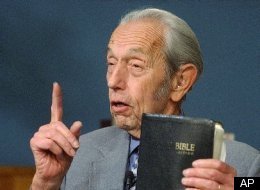 |
| Harold Camping |
I see this tragic episode as one gigantic mess, which God's people will be cleaning up for years. I, for one, am not very sympathetic to Mr. Camping, or to those who follow him. Here's why:
1). He's done this before. 1994? anyone??? If Camping lives much longer (he's 89), he'll likely do this again. As one of my favorite philosophers, Dirty Harry, once put it when his police superior questioned whether the serial killer (so wonderfully played by Andy Robinson) would continue to kill, Harry replied, "Of course he will. He likes it." You cannot tell me that however Camping came to this particular date for the Lord's return, and however sincere he might he be in his calculations, that the man does not love the media attention. Why else spend all that money on an "in your face" ad campaign with buses and billboards across the country? Camping likes the hubbub way too much. Since someone's past behavior is the best predictor of their future behavior, if given the chance, Camping will do it again.
2). Camping was disciplined by his church, and never once demonstrated the slightest hint of repentance. When Camping was removed from his office for his unbiblical speculations, Camping's response was to declare that the church age was over, and that people should leave their churches! (see Bob Godfrey's account of this--Godfrey on Harold Camping). Harold Camping is not some grandfatherly old man who has weird views on things (every church has a few of these). This is a man, who, when he did not get his way, sought to create widescale schism and division in the church. How can we not conclude that many among his followers are schismatics who have followed their master in his sin?
3). Camping is not a theological conservative defending the faith, he's a theological radical, and has a dangerous hermeneutic. Camping gained a following among Reformed cultural conservatives by defending the view that only men should hold the office of minister, elder and deacon, that evolutionary thought had no place in Christian colleges, and that the rampant immorality of our age cannot go unchallenged nor be accepted by Christians. Meanwhile, the "conservative" Camping was using some outlandish and distorted hermeneutical method to calculate the day of Christ's return and telling everyone who would listen that he was right and that anyone who challenged him had no authority to do so. Since when did theological conservatives attack the perspicuity of Scripture? Or champion "private interpretation" while mocking the teaching office and disciplinary authority of the church?
4). Someone has to say it -- the man is a false teacher and a kook. My sense is that Camping falls within the exhortation given by Paul in Romans 16:17 (and elsewhere) -- such people are to be avoided. Camping is a false teacher, plain and simple. Anyone who repeatedly pulls the kinds of shenanigans he has should have no credibility. Non-Christians see him for what he is. Yet, Christians feel ashamed about calling him out on the same grounds--when Scripture requires that we do so! Yes, we need to pray for his repentance, and yes, we need to be merciful to those whom he has deceived. But given the way the man handles God's word, he is self-edvidently a kook. He has no business being labeled a "teacher." And it is tragic that he has used his vast radio empire to deceive so many.
5). The only prophecy which will be fulfilled in association with Harold Camping is 2 Peter 3:3! Scoffers will come, and sadly, Camping has given the scoffers a whole bunch of ammunition. This is why is is so vital that Christians be clear to everyone who will listen, that despite this man's false prophecy, the blessed hope awaits all those who are Christ's, and the day of judgment will come upon those who are not. This is a serious matter, and Christ will not be mocked.
This, then, is why it is so important to expose this man for who and what he is--a false prophet, a schismatic and a kook, lest anyone think that Jesus will not return when we least expect it, to judge the world, raise the dead, and make all things new.
And frankly, it is sad that so many Christians expect non-Christians to do our job for us.
Saturday, May 14
The Indomitable Necessity of Prayer

Over the years I have enjoyed Spurgeon’s Morning and Evening Devotions. I’d highly recommend your getting your own copy. It is full of Christ exalting doctrine, well-phrased truth, and good sage common sense. I don’t read it as consistently now as when I first received my own copy in the mid-seventies, but I do have it as part of my Logos Bible software, on my phone, and in book form on my bedside table. As I was heading to bed the other night, I simply cracked the book, opened to the following selection and I was mesmerized. And since that doesn’t readily happen, I did what anyone would do, I scoured this entry with profit, then read it again the next morning, again, and again. Something in it caught my heart’s eye. Perhaps it will do likewise for you . . .
“Continue in prayer.” Colossians 4:2
It is interesting to remark how large a portion of Sacred Writ is occupied with the subject of prayer, either in furnishing examples, enforcing precepts, or pronouncing promises.
We scarcely open the Bible before we read, “Then began men to call upon the name of the Lord;” and just as we are about to close the volume, the “Amen” of an earnest supplication meets our ear.
Instances are plentiful. Here we find a wrestling Jacob—there a Daniel who prayed three times a day—and a David who with all his heart called upon his God. On the mountain we see Elias; in the dungeon Paul and Silas. We have multitudes of commands, and myriads of promises.
What does this teach us, but the sacred importance and necessity of prayer? We may be certain that whatever God has made prominent in his Word, he intended to be conspicuous in our lives.
If he has said much about prayer, it is because he knows we have much need of it. So deep are our necessities, that until we are in heaven we must not cease to pray. Dost thou want nothing? Then, I fear thou dost not know thy poverty. Hast thou no mercy to ask of God? Then, may the Lord’s mercy show thee thy misery!
A prayerless soul is a Christless soul. Prayer is the lisping of the believing infant, the shout of the fighting believer, the requiem of the dying saint falling asleep in Jesus. It is the breath, the watchword, the comfort, the strength, the honour of a Christian.
If thou be a child of God, thou wilt seek thy Father’s face, and live in thy Father’s love.
Pray that . . . thou mayst be holy, humble, zealous, and patient; have closer communion with Christ, and enter oftener into the banqueting-house of his love. Pray that thou mayst be an example and a blessing unto others, and that thou mayst live more to the glory of thy Master.
Subscribe to:
Posts (Atom)