Friday, May 27

DGM-Are Evangelicals Doctrinally Weak?

Thanks to DGM, this quotation does address itself to an issue we must consider and correct if the church is to honor her all-powerful LORD and fulfill the Great Commission. After reading the following, consider that we have the same Holy Spirit power available to empower the same holy gospel and carry it home to man's hearts no matter how recalcitrant they may be. Let us correct this gross error by trusting more the power of God and depending far less on glitz, innovation, and advertising. In days of awakening light, it has always been humble prayer and faithfully proclaimed doctrinal teaching that God has used to pierce the heart and revive the soul. 

In the book God’s Passion for His Glory: Living the Vision of Jonathan Edwards, Piper writes about the present state of evangelicalism:

I resonate with the lament of Os Guinness and David Wells that evangelicalism today is basking briefly in the sunlight of hollow success. Evangelical industries of television and radio and publishing and music recordings, as well as hundreds of growing mega-churches and some highly visible public figures and political movements, give outward impressions of vitality and strength. But both Wells and Guinness, in their own ways, have called attention to the hollowing out of evangelicalism from within.

In other words, the strong timber of the tree of evangelicalism has historically been the great doctrines of the Bible—God’s glorious perfections, man’s fallen nature, the wonders of redemptive history, the magnificent work of redemption in Christ, the saving and sanctifying work of grace in the soul, the great mission of the church in conflict with the world and the flesh and the devil, and the greatness of our hope of everlasting joy at God’s right hand. These things once defined us and were the strong fiber and timber beneath the fragile leaves and fruit of our religious experiences. But this is the case less and less. And that is why the waving leaves of success and the sweet fruit of prosperity are not as auspicious to David Wells and Os Guinness as they are to many. It is a hollow triumph, and the tree is getting weaker and weaker while the branches are waving in the sun.

John Piper, God’s Passion for His Glory: Living the Vision of Jonathan Edwards (Wheaton, IL: Crossway, 1998), 67-68.

Thursday, May 26

Edward Payson on the Duty of Loving God

I submit this to you for two reasons: 1) in order to suggest this wonderful book from Solid Ground Christian Books, Legacy of a Legend which contains snippets from Edward Payson (1783-1827), one of the godliest leaders during the early 1800's in America. And then, 2) I am quoting the following reading which I believe will commend itself to your hearts and hopefully encourage you to purchase this little book for yourselves. 

From the back of the book: 
"Hundreds and even thousands named their sons after him in hopes that they would grow up to be like him. This volume is a fitting introduction to such a great man who walked with God, and longed that others would join him. Legacy of a Legend brings this forgotten saint back to a church desperately in need of heroes. Even a cursory glance through the Table of Contents will attract anyone concerned for their immortal soul." On loving God, Payson writes:
We ought to love God because he has given us the power to love. He might have formed us gloomy, morose, misanthropic beings, destitute of all the social affections; without the power of loving any object, and strangers to the happiness of being beloved. Should God withdraw into himself, not only all the amiable qualities which excite love, but the very power of loving, would vanish from the world, and we should not only, like the evil spirits, become perfectly hateful, but should like them, hate one another.

Every object which can be presented to us has a claim on our affection corresponding to its character. If any object be admirable, it possesses a natural and inherent claim on our admiration; if it be venerable, it has a claim to our reverence; if it be terrible, it demands our fear; if it be beautiful and amiable, it claims and deserves our love. But God is perfectly and infinitely lovely; nay, he is excellence and loveliness itself. If you doubt this, ask those who can tell you. Ask Christ, . . . ask the holy angels, . . . . Ask good men in all ages, . . . Ask everything beautiful and amiable in the universe, and it will tell you that all its beauty is but a faint reflection of his. . . . But if God be thus infinitely lovely, we are under infinite obligations to love him; obligations from which he himself cannot release us but by altering his character, and ceasing to be lovely.
I don't know how this kind of writing affects you, but it is the kind that godly men of all ages love to discuss. It is endemic to our day that such talk sounds dated and therefore to many, obsolete. Please do not think so. Go the other way entirely. Seek out such men and women who write plainly of God's beauty. 

Monday, May 23

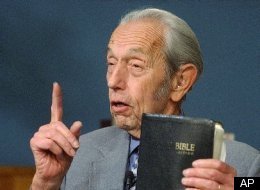
My Take (and a Rather Unsympthetic One at That) On Harold Camping and His Followers

Well, this is Kim Riddlebarger's "take" on Harold Camping. Read his blog HERE. He knows much more about this than I, so I am "borrowing brains." WARNING, it's straightforward, what we might call "in your face!" May I add . . . and needed!

Dr. Kim Riddlebarger is senior pastor of Christ Reformed Church in Anaheim, California (www.christreformed.org), and co-host of the popular White Horse Inn, a radio-internet talk show which first went on the air in 1990 and which can be heard here: (http://www.whitehorseinn.org/).

Harold Camping
Frankly, this whole Harold Camping mess ticks me off.  Since I write and teach in the field of eschatology, people expect me to say something.  Yet, I'm not sure many of you will appreciate my take on this.  I'm not a happy "camper."

I see this tragic episode as one gigantic mess, which God's people will be cleaning up for years.  I, for one, am not very sympathetic to Mr. Camping, or to those who follow him.  Here's why:

1).  He's done this before.  1994? anyone???  If Camping lives much longer (he's 89), he'll likely do this again.  As one of my favorite philosophers, Dirty Harry, once put it when his police superior questioned whether the serial killer (so wonderfully played by Andy Robinson) would continue to kill, Harry replied, "Of course he will.  He likes it."  You cannot tell me that however Camping came to this particular date for the Lord's return, and however sincere he might he be in his calculations, that the man does not love the media attention.  Why else spend all that money on an "in your face" ad campaign with buses and billboards across the country?  Camping likes the hubbub way too much.  Since someone's past behavior is the best predictor of their future behavior, if given the chance, Camping will do it again.

2).  Camping was disciplined by his church, and never once demonstrated the slightest hint of repentance.  When Camping was removed from his office for his unbiblical speculations, Camping's response was to declare that the church age was over, and that people should leave their churches!  (see Bob Godfrey's account of this--Godfrey on Harold Camping).  Harold Camping is not some grandfatherly old man who has weird views on things (every church has a few of these).  This is a man, who, when he did not get his way, sought to create widescale schism and division in the church.  How can we not conclude that many among his followers are schismatics who have followed their master in his sin?

3).  Camping is not a theological conservative defending the faith, he's a theological radical, and has a dangerous hermeneutic.  Camping gained a following among Reformed cultural conservatives by defending the view that only men should hold the office of minister, elder and deacon, that evolutionary thought had no place in Christian colleges, and that the rampant immorality of our age cannot go unchallenged nor be accepted by Christians.  Meanwhile, the "conservative" Camping was using some outlandish and distorted hermeneutical method to calculate the day of Christ's return and telling everyone who would listen that he was right and that anyone who challenged him had no authority to do so.  Since when did theological conservatives attack the perspicuity of Scripture?  Or champion "private interpretation" while mocking the teaching office and disciplinary authority of the church?

4).  Someone  has to say it -- the man is a false teacher and a kook.  My sense is that Camping falls within the exhortation given by Paul in Romans 16:17 (and elsewhere) -- such people are to be avoided.  Camping is a false teacher, plain and simple.  Anyone who repeatedly pulls the kinds of shenanigans he has should have no credibility.  Non-Christians see him for what he is.  Yet, Christians feel ashamed about calling him out on the same grounds--when Scripture requires that we do so!  Yes, we need to pray for his repentance, and yes, we need to be merciful to those whom he has deceived.  But given the way the man handles God's word, he is self-edvidently a kook.  He has no business being labeled a "teacher."  And it is tragic that he has used his vast radio empire to deceive so many.

5).  The only prophecy which will be fulfilled in association with Harold Camping is 2 Peter 3:3!  Scoffers will come, and sadly, Camping has given the scoffers a whole bunch of ammunition.  This is why is is so vital that Christians be clear to everyone who will listen, that despite this man's false prophecy, the blessed hope awaits all those who are Christ's, and the day of judgment will come upon those who are not.   This is a serious matter, and Christ will not be mocked.

This, then, is why it is so important to expose this man for who and what he is--a false prophet, a schismatic and a kook, lest anyone think that Jesus will not return when we least expect it, to judge the world, raise the dead, and make all things new.

And frankly, it is sad that so many Christians expect non-Christians to do our job for us.

Saturday, May 14

The Indomitable Necessity of Prayer


Over the years I have enjoyed Spurgeon’s Morning and Evening Devotions. I’d highly recommend your getting your own copy. It is full of Christ exalting doctrine, well-phrased truth, and good sage common sense. I don’t read it as consistently now as when I first received my own copy in the mid-seventies, but I do have it as part of my Logos Bible software, on my phone, and in book form on my bedside table. As I was heading to bed the other night, I simply cracked the book, opened to the following selection and I was mesmerized. And since that doesn’t readily happen, I did what anyone would do, I scoured this entry with profit, then read it again the next morning, again, and again. Something in it caught my heart’s eye. Perhaps it will do likewise for you . . .

“Continue in prayer.” Colossians 4:2

It is interesting to remark how large a portion of Sacred Writ is occupied with the subject of prayer, either in furnishing examples, enforcing precepts, or pronouncing promises.

We scarcely open the Bible before we read, “Then began men to call upon the name of the Lord;” and just as we are about to close the volume, the “Amen” of an earnest supplication meets our ear.

Instances are plentiful. Here we find a wrestling Jacob—there a Daniel who prayed three times a day—and a David who with all his heart called upon his God. On the mountain we see Elias; in the dungeon Paul and Silas. We have multitudes of commands, and myriads of promises.

What does this teach us, but the sacred importance and necessity of prayer? We may be certain that whatever God has made prominent in his Word, he intended to be conspicuous in our lives.

If he has said much about prayer, it is because he knows we have much need of it. So deep are our necessities, that until we are in heaven we must not cease to pray. Dost thou want nothing? Then, I fear thou dost not know thy poverty. Hast thou no mercy to ask of God? Then, may the Lord’s mercy show thee thy misery!

A prayerless soul is a Christless soul. Prayer is the lisping of the believing infant, the shout of the fighting believer, the requiem of the dying saint falling asleep in Jesus. It is the breath, the watchword, the comfort, the strength, the honour of a Christian.

If thou be a child of God, thou wilt seek thy Father’s face, and live in thy Father’s love.

Pray that . . .  thou mayst be holy, humble, zealous, and patient; have closer communion with Christ, and enter oftener into the banqueting-house of his love. Pray that thou mayst be an example and a blessing unto others, and that thou mayst live more to the glory of thy Master. 


Charles H. Spurgeon, Morning and Evening : Daily Readings, Complete and unabridged; New modern edition. (Peabody, MA: Hendrickson Publishers, 2006).

Wednesday, May 11

Do We HAVE to Outgrow Joy?


Most folks love to see children playing and laughing, laughing at, . . . well, . . . just about anything! It's great, isn't it? Warren Wiersbe writes in True Worship that children begin with a great capacity for wonder; they can stare for hours at an ant hill! Sadly, they lose 90% of that capacity by the time they're five! That's depressing! What happens that we grow so sour, so dour? Well, I think the pundits would offer, . . . "Life happens." Yep, we get a little older and we suffer sin in it's many forms along with rejection, trials, failure and death. And this hangs over us. Now everyone faces these things. And the question must be broached, "Do we have to outgrow joy?" 

First, I'd affirm that we have to face up to the fact that we live in a fallen world. Sin abounds and it will affect all of us. That alone will dampen the most optimistic human being! And we cannot turn a deaf ear to sin's sound nor a blind eye to it's presence. But those without Christ will hardly know of any positive spin they might put on such troubles. Let me give you this poem which I heard on "The Prairie Home Companion" with Garrison Keillor. It's touching for it's reality, and good poetry, but it could also be a bit depressing.

The Best Year of Her Life


When my two-year-old daughter
sees someone come through the door
whom she loves, and hasn't seen for a while,
and has been anticipating
she literally shrieks with joy.


I have to go into the other room
so that no one will notice the tears in my eyes.

Later, after my daughter has gone to bed,

I say to my wife,

"She will never be this happy again,"

and my wife gets angry and snaps,
"Don't you dare communicate your negativism to her!"
And, of course, I won't, if I can possibly help it,
and of course I fully expect her
to have much joy in her life,
and, of course, I hope to be able
to contribute to that joy —
I hope, in other words, that she'll always
be happy to see me come through the door—

but why kid ourselves — she, like every child,

has a life of great suffering ahead of her,
and while joy will not go out of her life,
she will one of these days cease to actually,
literally, jump and shriek for joy.


"The Best Year of Her Life" by Gerald Locklin, from Men of Our Time. © University of Georgia Press, 1992.
Second, something CAN be done about this problem! My pastor's heart yearns to say to that young girl, you may grow older, but you don't have to become cynical or jaded by sin! The prophet Jeremiah querried, "Is there no balm [cure] in Gilead? Is there no Physician there?" (Jer. 8:22). Oh, there most certainly is a Physician. [Jesus] said, “Those who are well have no need of a physician, but those who are sick (Matthew 9:12). Jesus summarized it quite well when he said, The thief comes only to steal and kill and destroy. I came that they may have life and have it abundantly (John 10:10). Indeed, the devil only desires to steal joy and true happiness from every soul on earth! That's all. But Jesus came in order to grant life (by faith) to all who call upon him. And notice, that's abundant life! 

So, do we have to cease literally shrieking for joy? Well, perhaps we won't shriek like that of an immature, innocent child. But we can after all the worst has been done around us (and even to a great degree done within us) still find abundant joy. How? Because Jesus knew quite well that he was coming NOT to save already whole people, but those who's lives had fallen apart. No, we don't kid ourselves, such joy is for those who's hope is grounded in the Lord alone. And from him we will never fail to be blessed and find joy.

Have you?

Tuesday, May 10

True Christianity Cannot Be Tolerant of Other Religions


Depending on what we mean by "tolerant." If we mean gentle and kind. That should go without saying. It should, but perhaps it needs reiterating. But if it means viewing them as equals, then no we must not, we CANNOT view them as equals since no other Jesus Christ has been offered as the sacrifice for our sins and Savior of the world.

The Lloyd-Jones quotation yesterday and this one today combine to reinforce what men of God have taught regarding the exclusivity of the church if she is to be useful, that is, if she is to fulfill her God-given role. I quote these in light of the seeming wholesale departure by many into a more "enlightened" approach to evangelism. It is not new, nor is it the church's commission to create any kind of culture or societal bridge into the world unless that bridge is Jesus Christ, and him crucified! Jude exhorts, And have mercy on those who doubt; save others by snatching them out of the fire; to others show mercy with fear, hating even the garment stained by the flesh (Jude 22–23). So, there IS a place for ministry with "teeth." Snatching someone from the fire is never a calm prospect. But it is an emergency, and they need help . . . now! If the church doesn't give a clarion call to those within her hearing, then how will the troubled know what to do? Hear what another defender of the faith, J. Gresham Machen wrote:
But when I say that a true Christian church is radically intolerant, I mean simply that the church must maintain the high exclusiveness and universality of its message. It presents the gospel of Jesus Christ not merely as one way of salvation, but as the only way. It cannot make common cause with other faiths. It cannot agree not to proselytize. Its appeal is universal, and admits of no exceptions. All are lost in sin; none may be saved except by the way set forth in the gospel. Therein lies the offense of the Christian religion, but therein lies also it glory and its power. A Christianity tolerant of other religions is just no Christianity at all.                                       
J. GRESHAM MACHEN, “The Church: Doctrinal & Intolerant”
 

Monday, May 9

The Church That is Different Attracks the World


Our Lord attracted sinners because He was different. They drew near to Him because they felt that there was something different about Him… And the world always expects us to be different. This idea that you are going to win people to the Christian faith by showing them that after all you are remarkably like them, is theologically and psychologically a profound blunder.        
The glory of the gospel is that when the Church is absolutely different from the world, she invariably attracts it. It is then that the world is made to listen to her message, though it may hate it at first. That is how revival comes. That must also be true of us as individuals. It should not be our ambition to be as much like everybody else as we can, though we happen to be Christian, but rather to be as different from everybody who is not a Christian as we can possibly be. Our ambition should be to be like Christ, the more like Him the better. And the more like Him we become, the more useful to the world we will be. 
                                                                          
D. Martyn Lloyd-Jones, Preaching and Preachers