Thursday, August 18

Gospel Victory in Algeria!

Algeria vs USA 2010 World Cup Soccer


From Spirit of Martyrdom website.

Before 1985, there were no Christians for 1200 years in Algeria. Saint Augustine and others were from this region of Africa, but by the 900s Islam wiped out Christianity. In 1985, a group of amateur soccer players from Switzerland vacationed to the Kabylie region, Algeria. The Swiss asked if their local soccer team wanted to play in a scrimmage. The team agreed but said their best player was  really sick and asked if the Swiss had any medicine. The Swiss did not have medicine but offered to pray. When the Swiss prayed for the Algerian player, they asked that “our Father in heaven” heal him. The player was instantly healed. The rest of the Algerian soccer team was amazed and intrigued. “Who is this Father you pray to and how does he heal?” they asked.  In the Qur’an there is no title of “Father” for Allah, so their curiosity caused them to further question what the Swiss were talking about. The Swiss explained to them the gospel. All 11 soccer players received faith in Christ and right away told others about their experience. The Algerian soccer players began to pray for the physical needs of others and many were healed. This event began the modern-day revival in Algeria which has grown to over 100,000 Christians in the past 26 years. The truly amazing miracle about all of this is that these men and women had no knowledge of Christ.  It was two years later in 1987 that the first French Bible and then Arabic Bible were given to these new believers. This year marks the completion of the first Berber Bible in history (which is their native language.)

However, this enormous growth did not come without persecution. One of the soccer players tried to share his new faith with his family and they did not want to hear it. They beat him and his life was threatened. For 7 years, he was on the move until 1992 when his family asked him to come back to the village. The risk of visiting his home village was very high; but God had other plans for him.  The village elders grilled him about his Christian faith. The wisdom of his answers impressed the elders and after their discussion the elders simply walked away. In due time, his family came to faith in Christ.
 
God is adding Muslims to faith in Christ like never before in history. God invites us to have a part of this work with prayers and a bold witness of faith. Every Muslim background believer is a persecuted believer. If the Algerian believers can be bold in their faith, we encourage you to be bold in your prayers and faith here in America. In these last two weeks of our Algerian Freedom campaign, we ask you to persevere in prayer and this week to share the situation of Christians in Algeria with one other person.
 

Wednesday, August 17

The Gospel: Cool, or Glorious?


One of the most persistent issues in my Christian experience over the last fifty years has been the presentation of the Gospel as if it were a popular, cool thing to be saved. It has been pervasive in America. What I couldn't have known (until years later) was that someone like A. W. Tozer saw this way back in the pre early 60's! In my naivete, I imagined that those were the "good ol' days" and that only in subsequent years did such an attitude arise! Guess I was wrong. I suspect such an approach would be inevitable in a consumeristic culture, where everything draws it's value from it's ability to pad the coffers of it's owner with yet one more toy. That God would save anyone is a most salutary blessing, bar none! But that somehow doesn't seem to be enough to many in gospel churches these days. See if this doesn't ring true in our culture.    

But we have renounced the hidden things of shame, not walking in craftiness and handling the word of God deceitfully, but by manifestation of the truth commending ourselves to every man's conscience in the sight of God. --2 Corinthians 4:2

Here again is seen the glaring discrepancy between Biblical Christianity and that of present-day evangelicals, particularly in the United States....

To make converts here we are forced to play down the difficulties and play up the peace of mind and worldly success enjoyed by those who accept Christ. We must assure our hearers that Christianity is now a proper and respectable thing and that Christ has become quite popular with political bigwigs, well-to-do business tycoons and the Hollywood swimming pool set. Thus assured, hell-deserving sinners are coming in droves to "accept" Christ for what they can get out of Him; and though one now and again may drop a tear as proof of his sincerity, it is hard to escape the conclusion that most of them are stooping to patronize the Lord of glory much as a young couple might fawn on a boresome but rich old uncle in order to be mentioned in his will later on.

Born After Midnight, 17.

Now, what remains for us to do is to repent of such a bowdlerizing of the glorious gospel of our Lord Jesus Christ and present it as it is presented in the New Testament, warnings and all. Need it be reiterated that God knew what He was doing when He gave us the crucified Jesus? Have we not yet learned that man is missing more than he imagines, not the least of which is a clear perception of what is truth? What was needed was good news that cuts through our world, and conquers our sin, not one that blends with it or sugar-coats it. We don't need another toy! We need the joyous victory over sin and self that can only be accomplished by the RE-creation of our souls by the atoning work of Jesus Christ. That's glorious!

Friday, August 5

Are Christians Afraid of the Exclusive Gospel?

Truth forces people to take sides. Most today don't like that and even imagine those evil who try. Pilate asked basically the same question postmoderns have posed, "What is truth?" Worse, it seems, they say there is no truth to be known (keep reading). This is not a new concern. Michael Horton, in his endorsement of this book writes: “Although religious pluralism is often treated as a ‘postmodern’ phenomenon, it has always been the world’s most fundamental challenge to the gospel." True, and each generation of warriors must take up the sword afresh to fend off such evil.

Learning On Vacation
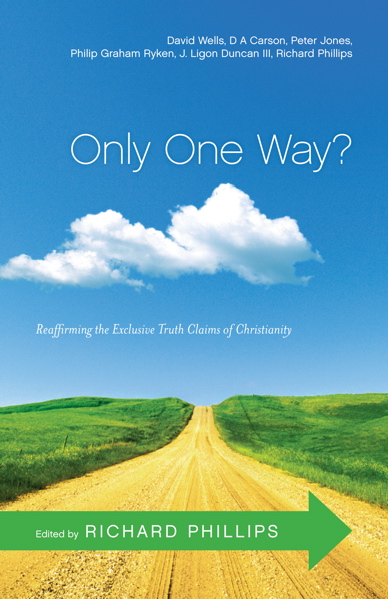
While away on vacation last week, I made good use of my new Kindle and read Only One Way: Reaffirming the Truth Claims of Christianity. It is a compilation of addresses given to the 2005 Philadelphia Conference on Reformed Theology (PCRT). I heartedly recommend the entire book. Here, I am focusing on one chapter that caught my attention, the address given by Philip Ryken, "One Truth." He surfaces an alarming statistic from George Barna, a Christian market researcher with an emphasis on religious points of view. He states that only 9 percent of evangelical students now believe in anything called "absolute truth." Really? How can that honestly be? Isn't that about like football players arguing over the existence of a football?! If you've got no truth, you've got nothing. Os Guinness, Ryken points out, has also observed, "A solid sense of truth is foundering in America at large. Vaporized by critical theories, obscured by clouds of euphemism and jargon, outpaced by humor and hype, overlooked for style and image, and eroded by advertising, truth in America is anything but marching on." Then Guinness draws this "telling indictment": "With magnificent exceptions, evangelicals reflect this truth-decay and reinforce it. . . . Contemporary evangelicals are no longer people of the truth." He has a point.

What We're Up Against
Postmodernism doesn't just affirm that truth is a matter of our opinion (subjectivity), they go further and claim "that there is no truth, with a capital T." Now this is not news to those who study this subject, whose eyes are on the religious horizon. Numerous books are on the market whose titles alone make this evident: Whatever Happened to Truth by Andreas Kostenberger, Truth Decay: Defending Christianity Against The Challenges of Postmodernism by Douglas Groothuis, and Alister McGrath's A Passion For Truth: The Intellectual Coherence of Evangelicalism, to name a few. To all of this we defenders of the faith echo the cry of the Psalmist, "If the foundations are destroyed, what can the righteous do?" (Ps. 11:3). Ministers need to be, among other things, capable builders who understand the basics of their trade. Foundation and edify, along with building a house are terms applied to the church, terms with which we must not only become familiar but erudite . . . and unbending.

When reading this book, one discovers that the problem throughout is not one of intellectual non-feasibility, but one of will. I hear in my ear that defiant cry from long ago, "We will not have this man to rule over us." It was the cry of the Garden of Eden, it was the cry of Israel in desiring a king, and it certainly was the cry of the chosen when they rejected Jesus Christ. So, while we may grow alarmed (hopefully) at the vortex that threatens to suck all of us in, we take great hope in the fact that if and until man is drawn by God, he will not be able to see nor believe the truth (John 6:44). The first century was not a Jesus-friendly atmosphere, nor were the Athenian philosophers clammering after "the Truth" in the person of Jesus the resurrected Son of God. Oh, no! But many were saved just the same. We also, if we keep Jesus Christ front and center will likewise find godly success. 

I conclude by stating two things: 1) Recognize the seriousness of the error we face today, but also 2) Embrace the clarity of the Gospel message as it is found in Jesus Christ. Those who do are not wanting in success, . . . God's success.

Tuesday, August 2

How Do We Know If We Love Christ? (Thanks, DGM)

Loving J. C. Ryle as I do, and especially his book, Holiness, this entry from DGM met with my joy, so I gladly pass it on to you. Before you read how Ryle answers this absolutely critical question, may I say something? 

Frankly, I feel at a loss as to how I might emphasize the centrality of this consideration. I mean, we can emphasize something, and most of the church will agree as to it's importance. But there it may die. We hear it. We can even agree with it. But it does not click with us. It does not enter our hearts! And therein lies the tragedy. And I do not think "tragedy" too exaggerated a term to use at all! We can talk theology and denominations, sure. But what Ryle deals with here is ABSOLUTELY ESSENTIAL--real honest-to-goodness love for our Lord and Savior, Jesus Christ. It simply cannot be stressed too much!! 
Have I got your attention yet? Sorry, I do not mean to sound condescending. For lack of love to Jesus in the fashion mentioned below is something which is far too little understood among the Bible-believing Christians I know, and therefore, far too little practiced. That must change. What will it take for Christians to realize this? I think nothing less than a Holy Spirit heart-opening revival in each of us! So often, the most important issues are the ones we so easily ignore. Ignore this one no longer. For Christ's sake, ignore it no longer. How, then DO we love Christ rightly?
J. C. Ryle writes:
1. If we love a person, we like to think about him. We do not need to be reminded of him. We do not forget his name or his appearance or his character or his opinions or his tastes or his position or his occupation... Well, it is just so between the true Christian and Christ!
2. If we love a person, we like to hear about him. We find a pleasure in listening to those who speak of him. We feel an interest in any report which others make of him... Well, it is just so between the true Christian and Christ!
3. If we love a person, we like to read about him. What intense pleasure a letter from an absent husband gives to a wife, or a letter from an absent son to his mother... Well, it is just so between the true Christian and Christ!
4. If we love a person, we like to please him. We are glad to consult his tastes and opinions, to act upon his advice and do the things which he approves... Well, it is just so between the true Christian and Christ!
5. If we love a person, we like his friends. We are favorably inclined to them, even before we know them. We are drawn to them by the common tie of common love to one and the same person... Well, it is just so between the true Christian and Christ!
6. If we love a person, we are jealous about his name and honor. We do not like to hear him spoken against, without speaking up for him and defending him... Well, it is just so between the true Christian and Christ!
7. If we love a person, we like to talk to him. We tell him all our thoughts, and pour out all our heart to him. We find no difficulty in discovering subjects of conversation... Well, it is just so between the true Christian and Christ!
8. Finally, if we love a person, we like to be always with him. Thinking and hearing and reading and occasionally talking are all well in their way. But when we really love people we want something more... Well, it is just so between the true Christian and Christ!

Holiness, (Darlington, England: Evangelical Press,) 247-249.