Wednesday, August 17

The Gospel: Cool, or Glorious?


One of the most persistent issues in my Christian experience over the last fifty years has been the presentation of the Gospel as if it were a popular, cool thing to be saved. It has been pervasive in America. What I couldn't have known (until years later) was that someone like A. W. Tozer saw this way back in the pre early 60's! In my naivete, I imagined that those were the "good ol' days" and that only in subsequent years did such an attitude arise! Guess I was wrong. I suspect such an approach would be inevitable in a consumeristic culture, where everything draws it's value from it's ability to pad the coffers of it's owner with yet one more toy. That God would save anyone is a most salutary blessing, bar none! But that somehow doesn't seem to be enough to many in gospel churches these days. See if this doesn't ring true in our culture.    

But we have renounced the hidden things of shame, not walking in craftiness and handling the word of God deceitfully, but by manifestation of the truth commending ourselves to every man's conscience in the sight of God. --2 Corinthians 4:2

Here again is seen the glaring discrepancy between Biblical Christianity and that of present-day evangelicals, particularly in the United States....

To make converts here we are forced to play down the difficulties and play up the peace of mind and worldly success enjoyed by those who accept Christ. We must assure our hearers that Christianity is now a proper and respectable thing and that Christ has become quite popular with political bigwigs, well-to-do business tycoons and the Hollywood swimming pool set. Thus assured, hell-deserving sinners are coming in droves to "accept" Christ for what they can get out of Him; and though one now and again may drop a tear as proof of his sincerity, it is hard to escape the conclusion that most of them are stooping to patronize the Lord of glory much as a young couple might fawn on a boresome but rich old uncle in order to be mentioned in his will later on.

Born After Midnight, 17.

Now, what remains for us to do is to repent of such a bowdlerizing of the glorious gospel of our Lord Jesus Christ and present it as it is presented in the New Testament, warnings and all. Need it be reiterated that God knew what He was doing when He gave us the crucified Jesus? Have we not yet learned that man is missing more than he imagines, not the least of which is a clear perception of what is truth? What was needed was good news that cuts through our world, and conquers our sin, not one that blends with it or sugar-coats it. We don't need another toy! We need the joyous victory over sin and self that can only be accomplished by the RE-creation of our souls by the atoning work of Jesus Christ. That's glorious!

Friday, August 5

Are Christians Afraid of the Exclusive Gospel?

Truth forces people to take sides. Most today don't like that and even imagine those evil who try. Pilate asked basically the same question postmoderns have posed, "What is truth?" Worse, it seems, they say there is no truth to be known (keep reading). This is not a new concern. Michael Horton, in his endorsement of this book writes: “Although religious pluralism is often treated as a ‘postmodern’ phenomenon, it has always been the world’s most fundamental challenge to the gospel." True, and each generation of warriors must take up the sword afresh to fend off such evil.

Learning On Vacation
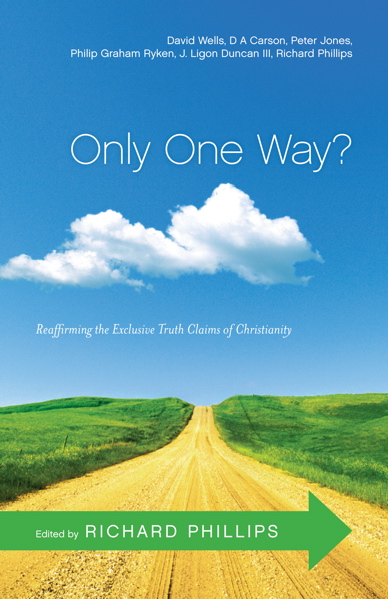
While away on vacation last week, I made good use of my new Kindle and read Only One Way: Reaffirming the Truth Claims of Christianity. It is a compilation of addresses given to the 2005 Philadelphia Conference on Reformed Theology (PCRT). I heartedly recommend the entire book. Here, I am focusing on one chapter that caught my attention, the address given by Philip Ryken, "One Truth." He surfaces an alarming statistic from George Barna, a Christian market researcher with an emphasis on religious points of view. He states that only 9 percent of evangelical students now believe in anything called "absolute truth." Really? How can that honestly be? Isn't that about like football players arguing over the existence of a football?! If you've got no truth, you've got nothing. Os Guinness, Ryken points out, has also observed, "A solid sense of truth is foundering in America at large. Vaporized by critical theories, obscured by clouds of euphemism and jargon, outpaced by humor and hype, overlooked for style and image, and eroded by advertising, truth in America is anything but marching on." Then Guinness draws this "telling indictment": "With magnificent exceptions, evangelicals reflect this truth-decay and reinforce it. . . . Contemporary evangelicals are no longer people of the truth." He has a point.

What We're Up Against
Postmodernism doesn't just affirm that truth is a matter of our opinion (subjectivity), they go further and claim "that there is no truth, with a capital T." Now this is not news to those who study this subject, whose eyes are on the religious horizon. Numerous books are on the market whose titles alone make this evident: Whatever Happened to Truth by Andreas Kostenberger, Truth Decay: Defending Christianity Against The Challenges of Postmodernism by Douglas Groothuis, and Alister McGrath's A Passion For Truth: The Intellectual Coherence of Evangelicalism, to name a few. To all of this we defenders of the faith echo the cry of the Psalmist, "If the foundations are destroyed, what can the righteous do?" (Ps. 11:3). Ministers need to be, among other things, capable builders who understand the basics of their trade. Foundation and edify, along with building a house are terms applied to the church, terms with which we must not only become familiar but erudite . . . and unbending.

When reading this book, one discovers that the problem throughout is not one of intellectual non-feasibility, but one of will. I hear in my ear that defiant cry from long ago, "We will not have this man to rule over us." It was the cry of the Garden of Eden, it was the cry of Israel in desiring a king, and it certainly was the cry of the chosen when they rejected Jesus Christ. So, while we may grow alarmed (hopefully) at the vortex that threatens to suck all of us in, we take great hope in the fact that if and until man is drawn by God, he will not be able to see nor believe the truth (John 6:44). The first century was not a Jesus-friendly atmosphere, nor were the Athenian philosophers clammering after "the Truth" in the person of Jesus the resurrected Son of God. Oh, no! But many were saved just the same. We also, if we keep Jesus Christ front and center will likewise find godly success. 

I conclude by stating two things: 1) Recognize the seriousness of the error we face today, but also 2) Embrace the clarity of the Gospel message as it is found in Jesus Christ. Those who do are not wanting in success, . . . God's success.

Tuesday, August 2

How Do We Know If We Love Christ? (Thanks, DGM)

Loving J. C. Ryle as I do, and especially his book, Holiness, this entry from DGM met with my joy, so I gladly pass it on to you. Before you read how Ryle answers this absolutely critical question, may I say something? 

Frankly, I feel at a loss as to how I might emphasize the centrality of this consideration. I mean, we can emphasize something, and most of the church will agree as to it's importance. But there it may die. We hear it. We can even agree with it. But it does not click with us. It does not enter our hearts! And therein lies the tragedy. And I do not think "tragedy" too exaggerated a term to use at all! We can talk theology and denominations, sure. But what Ryle deals with here is ABSOLUTELY ESSENTIAL--real honest-to-goodness love for our Lord and Savior, Jesus Christ. It simply cannot be stressed too much!! 
Have I got your attention yet? Sorry, I do not mean to sound condescending. For lack of love to Jesus in the fashion mentioned below is something which is far too little understood among the Bible-believing Christians I know, and therefore, far too little practiced. That must change. What will it take for Christians to realize this? I think nothing less than a Holy Spirit heart-opening revival in each of us! So often, the most important issues are the ones we so easily ignore. Ignore this one no longer. For Christ's sake, ignore it no longer. How, then DO we love Christ rightly?
J. C. Ryle writes:
1. If we love a person, we like to think about him. We do not need to be reminded of him. We do not forget his name or his appearance or his character or his opinions or his tastes or his position or his occupation... Well, it is just so between the true Christian and Christ!
2. If we love a person, we like to hear about him. We find a pleasure in listening to those who speak of him. We feel an interest in any report which others make of him... Well, it is just so between the true Christian and Christ!
3. If we love a person, we like to read about him. What intense pleasure a letter from an absent husband gives to a wife, or a letter from an absent son to his mother... Well, it is just so between the true Christian and Christ!
4. If we love a person, we like to please him. We are glad to consult his tastes and opinions, to act upon his advice and do the things which he approves... Well, it is just so between the true Christian and Christ!
5. If we love a person, we like his friends. We are favorably inclined to them, even before we know them. We are drawn to them by the common tie of common love to one and the same person... Well, it is just so between the true Christian and Christ!
6. If we love a person, we are jealous about his name and honor. We do not like to hear him spoken against, without speaking up for him and defending him... Well, it is just so between the true Christian and Christ!
7. If we love a person, we like to talk to him. We tell him all our thoughts, and pour out all our heart to him. We find no difficulty in discovering subjects of conversation... Well, it is just so between the true Christian and Christ!
8. Finally, if we love a person, we like to be always with him. Thinking and hearing and reading and occasionally talking are all well in their way. But when we really love people we want something more... Well, it is just so between the true Christian and Christ!

Holiness, (Darlington, England: Evangelical Press,) 247-249.

Sunday, July 31

M. Lloyd-Jones on Evangelical Unity


John Stott just passed away 3 days ago at the age of 90. An important and largely positive figure in the church for over half a century, he was also unfortunately part of an attempt to tear down necessary theological walls. At the risk of not being read, I am quoting in it's entirety a December 2005 POST from Guy Davies' blog, Exiled Preacher. The true church has suffered for too long from far too much accommodation. The message of the cross was never meant to "appeal" to the masses. But to hear so many today, one would think that's exactly the point toward which we Christians should be pressing. The opposite it true. Here is one voice presenting a clarion call to resist such compromise. I hope you will take the time to read this entire post. It explains a critical attitude which has prevailed since WW2, one about which all believers in Jesus Christ must be aware. Guy writes: 

2006 Will be the 25th anniversary of the death of Welsh Evangelical leader Martyn Lloyd-Jones. The great preacher has left a controversial legacy behind him. Next year also marks the 40th anniversary of his famous 1966 address to the Evangelical Alliance on "Evangelical Unity". Ironically, that address was the cause of great division in UK Evangelicalism. Much has been written about the events of this period and it is essential to get our facts right.
A Call for Evangelical Unity 

Dr Martyn Lloyd-Jones had long been concerned about the position of Evangelicals within the mixed denominations. He has been involved in Ecumenical discussions in the 1950’s, and he did not like what he saw. But most Evangelicals were content to remain in their theologically mixed denominations, having fellowship with other Evangelicals through the Evangelical Alliance and other agencies. 

In October 1966 the Evangelical Alliance convened a conference to discuss the issue of Christian Unity. Lloyd-Jones had already expressed his views to leaders of the EA in private. He was given opportunity to speak his mind in public. 

Lloyd-Jones argued that the setting up of the World Council of Churches in 1948 and the whole Ecumenical Movement had created an entirely new situation. The ambition of this movement, he argued is to create “territorial, comprehensive national churches” in which all the denominations could unite. He asked, “Are we content with just being an evangelical wing in a territorial church that will eventually include, and must, if it is to be a truly national and ecumenical church, the Roman Catholic Church?

Lloyd-Jones suggested that it was quite wrong for Evangelicals to be divided from each other by remaining in their denominations. 
You and I are evangelicals. We are agreed about these essentials of the faith and yet we are divided from one another…we spend most of our time apart from one another, and joined to and united with the people who deny and are opposed to the essential matters of salvation. We have our visible unity with them. Now, I say, that is sinful. 
Finally, “the Doctor” urged evangelicals to seize the historic opportunity to come out of their denominations and come together “as a fellowship, or an association, of evangelical churches”. 

Lloyd-Jones’ argument sounded so persuasive that the chairman John Stott was genuinely concerned that Evangelical ministers would leave the Church of England the next morning. He used his position as chairman to flatly contradict what “the Doctor” had said. 
I believe history is against what Dr Lloyd-Jones has said…Scripture is against him, the remnant was within the church not outside it. I hope no one will act precipitately… 
Alister McGrath, in his biography of J. I. Packer, wrote that, “‘the shadow of 1966’ has lingered over English evangelicalism ever since.” He is right, Lloyd-Jones made Evangelicals face up to the challenge of the Ecumenical Movement. Are we only to be a “wing” within this great Movement, or shall we stand together united in the gospel? These matters have become even more urgent with the advent of “Churches Together” - (A UK-wide ecumenical body). We are now in the position of Churches being affiliated to the Evangelical Alliance, the Baptist Union ( a theologically mixed denomination) and Churches Together. Evangelicalism has become just one theological option that is no more or less valid then Catholicism or Liberalism. This is what happens when we fail to think through the challenge of the Ecumenical Movement. 

Lloyd-Jones subsequently withdrew from the Evangelical Alliance and threw his weight behind the BEC. The BEC was founded in 1952 as an Evangelical response to the founding of the WCC in 1948. The founders were T. H. Bendor-Samuel and E. J. Poole-Connor of the FIEC and representatives of Evangelical Presbyterian Churches in Scotland and Ireland. The BEC was robustly anti-ecumenical, but also stood for Evangelical unity. The BEC was re-launched as Affinity in 2004. 

A Call for Separation 

A call to secede from the denominations was implicit in Lloyd-Jones’ 1966 call for Evangelical unity. In 1967, the Doctor gave the main address at the BEC Conference on “Martin Luther and his message for today.” He challenged Evangelicals who had wavered over their involvement in the denominations to consider their position. 
So I close with an appeal. The position round and about us is developing rapidly. The ecumenical movement is advancing day by day, and it is traveling in the direction of Rome. But it is not only heading to Rome, it is heading towards an amalgamation of so-called world religions, and will undoubtedly end as a great World Congress of faiths… 

What then are evangelicals to do in this situation? I reply by saying that we must heed a great injunction in Revelation 18:4: ‘Come out of her my people!’ ‘Come out of her, my people, that ye be not partakers of her sins, and that ye receive not of her plagues.’ Come out of it! But also come together into an association such as the BEC that stands for the truth and against compromise, hesitation, neutrality and everything that ministers to the success and plans of Rome and the ecumenical movement. Come out; come in! 
But Lloyd-Jones’ call was not heeded by all evangelicals. 

A Policy of Evangelical Integration 

In 1967 the first National Evangelical Anglican Congress met in Keele. John Stott was conference chairman. Stott, who, as we have seen, publicly disagreed with Lloyd-Jones in 1966, was determined that Evangelical Anglicans be fully involved in their denomination. Prior to the conference he set out his agenda: 
It is a tragic thing, however, that Evangelicals have a very poor image in the Church as a whole. We have acquired a reputation for narrow partisanship and obstructionism. We have to acknowledge this and for the most part we have no one but ourselves to blame. We need to repent and change. 
The Liberal, Anglo-Catholic Archbishop Ramsey was invited to address the conference. He told these Evangelicals that they should put experience before doctrine and that they should turn their backs on their old exclusive stance. The Archbishop stated that, “We are all called as Christians and as Anglicans we should be learning from one another.” 

The Conference responded to this call and accepted that all who were involved in ecumenical dialogue “have the right to be treated as Christians.” John Lawrence, who had long worked for a change of attitude among Evangelical Anglicans was well satisfied with the result: 
Now this wall is down Evangelicals will be heard in a new way, but this would not have happened if they had not shown that they are now ready to listen to others. 
As Lloyd-Jones had warned, this policy meant that Evangelicals had reduced themselves to being a mere wing in the great ecumenical project. Can we be content with that? Is it right to assume that Liberals who deny the virgin birth and resurrection of Christ “have the right to be treated as Christians?” 

We Stand alone Together! 

The attitude of Evangelicals to the ecumenical project is one of the pressing issues that we have to face in the 21st Century. Our stance should be that of the US 101st Airbourn Division, immortalised in the Band of Brothers TV series, "We stand alone together".

Saturday, July 30

The Church & the World--No Compromise!


When will the true Church ever get it through her head, there can be no coming together with the world? The message of the cross is foolishness to the world, Paul tells us in 1 Corinthians 1. That hasn't changed one bit. When the Church proclaims the truth as she ought, it intersects the world, and runs contrary to her. It condemns, it does not condone. The Gospel does not have to be spoken in an ugly manner for this to happen. It is simply the nature of the truth that it exposes lies. And people will not like that. Until the Spirit opens the eyes of any human, they will always view the truth in such a light. Let the Spirit open the eyes and all things change! We who love Jesus Christ, love the cross of Jesus Christ, also love the message of the cross. It is such a message the world must hear if she is to be saved from total destruction. It the message we had to hear as well. Listen to Tozer's take on this:

Therefore "Come out from among them and be separate," says the Lord. "Do not touch what is unclean, and I will receive you." --2 Corinthians 6:17

The church's mightiest influence is felt when she is different from the world in which she lives. Her power lies in her being different, rises with the degree in which she differs and sinks as the difference diminishes.

This is so fully and clearly taught in the Scriptures and so well illustrated in Church history that it is hard to see how we can miss it. But miss it we do, for we hear constantly that the Church must try to be as much like the world as possible, excepting, of course, where the world is too, too sinful....

Let us plant ourselves on the hill of Zion and invite the world to come over to us, but never under any circumstances will we go over to them. The cross is the symbol of Christianity, and the cross speaks of death and separation, never of compromise. No one ever compromised with a cross. The cross separated between the dead and the living. The timid and the fearful will cry "Extreme!" and they will be right. The cross is the essence of all that is extreme and final. The message of Christ is a call across a gulf from death to life, from sin to righteousness and from Satan to God.

The Set of the Sail, 35,36.

Friday, July 29

John Piper, How to Recognize a Wolf-In-The-Making

The following is from John Piper via Adrian Warnock's BLOG. Thanks to Adrian for selecting this quotation. It is indeed appropriate for these days! We had better listen to the wisdom in these words.
Adrian wrote:

This quote might be old, but it is bang up to date!
Let me just mention one feature to watch out for in the recognition of wolves. As I have watched the movement from biblical faithfulness to liberalism in persons and institutions that I have known over the years, this feature stands out: An emotional disenchantment with faithfulness to what is old and fixed, and an emotional preoccupation with what is new or fashionable or relevant in the eyes of the world.
Let’s try to say it another way: when this feature is prevalent, you don’t get the impression that a person really longs to bring his mind and heart into conformity to fixed biblical truth. Instead you see the desire to picture biblical truth as unfixed, fluid, indefinable, distant, inaccessible, and so open to the trends of the day.
So what marks a possible wolf-in-the-making is not simply that he rejects or accepts any particular biblical truth, but that he isn’t deeply oriented on the Bible. He is more oriented on experience. He isn’t captured by the great old faith once for all delivered to the saints. Instead he’s enamored by what is new and innovative.
A good elder can be creative. But the indispensable mark when it comes to doctrinal fitness is faithfulness to what is fixed in Scripture—disciplined, humble submission to the particular affirmations of the Bible—carefully and reverently studied and explained and cherished. When that spirit begins to go, there’s a wolf-in-the-making.
via Pastors, How to Recognize a Wolf-In-The-Making – Desiring God.

Wednesday, July 20

A Word for the Downcast

So many hurting souls within the bounds of Christianity. This is normal. And it is varied. That is, some may bring trouble on themselves by habitually living outside the bounds of God's will. There are consequences for that. Others, however, may be trying to walk the pilgrim life and still feel aches in their soul, depressions, rejections, etc. What are we to do with these? Sometimes we need an encouraging word. That's all. We're not going to abandon the faith or give up on God. No, we just need once in a while to hear a word of affirmation from the Savior. Alas, I hope that His word is enough for us! Hear this very helpful word from Charles Spurgeon. I simply love this text. If you're not familiar with it, I hope you'll fall in love with it as well.        
“A bruised reed shall he not break, and smoking flax shall he not quench.”
         — Matthew 12:20

What is weaker than the bruised reed or the smoking flax? A reed that groweth in the fen or marsh, let but the wild duck light upon it, and it snaps; let but the foot of man brush against it, and it is bruised and broken; every wind that flits across the river moves it to and fro. You can conceive of nothing more frail or brittle, or whose existence is more in jeopardy, than a bruised reed. Then look at the smoking flax—what is it? It has a spark within it, it is true, but it is almost smothered; an infant’s breath might blow it out; nothing has a more precarious existence than its flame. Weak things are here described, yet Jesus says of them, “The smoking flax I will not quench; the bruised reed I will not break.” Some of God’s children are made strong to do mighty works for him; God has his Samsons here and there who can pull up Gaza’s gates, and carry them to the top of the hill; he has a few mighties who are lion-like men, but the majority of his people are a timid, trembling race. They are like starlings, frightened at every passer by; a little fearful flock. If temptation comes, they are taken like birds in a snare; if trial threatens, they are ready to faint; their frail skiff is tossed up and down by every wave, they are drifted along like a sea bird on the crest of the billows—weak things, without strength, without wisdom, without foresight. Yet, weak as they are, and because they are so weak, they have this promise made specially to them. Herein is grace and graciousness! Herein is love and lovingkindness! How it opens to us the compassion of Jesus—so gentle, tender, considerate! We need never shrink back from his touch. We need never fear a harsh word from him; though he might well chide us for our weakness, he rebuketh not. Bruised reeds shall have no blows from him, and the smoking flax no damping frowns.


Charles H. Spurgeon, Morning and Evening : Daily Readings, Complete and unabridged; New modern edition. (Peabody, MA: Hendrickson Publishers, 2006).